Difference between revisions of "Store:QLMen09"
| Line 6: | Line 6: | ||
# the meter observable <math>M_A</math> giving outputs of the pointer of the apparatus <math>M</math>. | # the meter observable <math>M_A</math> giving outputs of the pointer of the apparatus <math>M</math>. | ||
An ''indirect measurement model'', introduced in Ozawa (1984)<ref name=": | An ''indirect measurement model'', introduced in Ozawa (1984)<ref name=":Ozawa M (1984)">Ozawa M. Quantum measuring processes for continuous observables. J. Math. Phys., 25 (1984), pp. 79-87. Google Scholar</ref> | ||
Quantum measuring processes for continuous observables | Quantum measuring processes for continuous observables | ||
| Line 36: | Line 37: | ||
|} | |} | ||
where <math>Tr_\mathcal{H}</math> is the partial trace over <math>\mathcal{H}</math> . Then, the map <math>x\rightarrow\Im_A(x)</math>turn out to be a quantum instrument. Thus, the statistical properties of the measurement realized by any indirect measurement model <math>(H,\sigma,U,M_A)</math> is described by a quantum measurement. We remark that conversely any quantum instrument can be represented via the indirect measurement model (Ozawa, 1984).<ref name=": | where <math>Tr_\mathcal{H}</math> is the partial trace over <math>\mathcal{H}</math> . Then, the map <math>x\rightarrow\Im_A(x)</math>turn out to be a quantum instrument. Thus, the statistical properties of the measurement realized by any indirect measurement model <math>(H,\sigma,U,M_A)</math> is described by a quantum measurement. We remark that conversely any quantum instrument can be represented via the indirect measurement model (Ozawa, 1984).<ref name=":Ozawa M (1984)">Ozawa M. Quantum measuring processes for continuous observables. J. Math. Phys., 25 (1984), pp. 79-87. Google Scholar</ref>Thus, quantum instruments mathematically characterize the statistical properties of all the physically realizable quantum measurements. | ||
Revision as of 17:54, 11 February 2023
4. Quantum instruments from the scheme of indirect measurements
The basic model for construction of quantum instruments is based on the scheme of indirect measurements. This scheme formalizes the following situation: measurement’s outputs are generated via interaction of a system Failed to parse (MathML with SVG or PNG fallback (recommended for modern browsers and accessibility tools): Invalid response ("Math extension cannot connect to Restbase.") from server "https://wikimedia.org/api/rest_v1/":): {\displaystyle S} with a measurement apparatus Failed to parse (MathML with SVG or PNG fallback (recommended for modern browsers and accessibility tools): Invalid response ("Math extension cannot connect to Restbase.") from server "https://wikimedia.org/api/rest_v1/":): {\displaystyle M} . This apparatus consists of a complex physical device interacting with Failed to parse (MathML with SVG or PNG fallback (recommended for modern browsers and accessibility tools): Invalid response ("Math extension cannot connect to Restbase.") from server "https://wikimedia.org/api/rest_v1/":): {\displaystyle S} and a pointer that shows the result of measurement, say spin up or spin down. An observer can see only outputs of the pointer and he associates these outputs with the values of the observable for the system Failed to parse (MathML with SVG or PNG fallback (recommended for modern browsers and accessibility tools): Invalid response ("Math extension cannot connect to Restbase.") from server "https://wikimedia.org/api/rest_v1/":): {\displaystyle S} . Thus, the indirect measurement scheme involves:
- the states of the systems Failed to parse (MathML with SVG or PNG fallback (recommended for modern browsers and accessibility tools): Invalid response ("Math extension cannot connect to Restbase.") from server "https://wikimedia.org/api/rest_v1/":): {\displaystyle S} and the apparatus Failed to parse (MathML with SVG or PNG fallback (recommended for modern browsers and accessibility tools): Invalid response ("Math extension cannot connect to Restbase.") from server "https://wikimedia.org/api/rest_v1/":): {\displaystyle M}
- the operator Failed to parse (MathML with SVG or PNG fallback (recommended for modern browsers and accessibility tools): Invalid response ("Math extension cannot connect to Restbase.") from server "https://wikimedia.org/api/rest_v1/":): {\displaystyle U} representing the interaction-dynamics for the system Failed to parse (MathML with SVG or PNG fallback (recommended for modern browsers and accessibility tools): Invalid response ("Math extension cannot connect to Restbase.") from server "https://wikimedia.org/api/rest_v1/":): {\displaystyle S+M}
- the meter observable Failed to parse (MathML with SVG or PNG fallback (recommended for modern browsers and accessibility tools): Invalid response ("Math extension cannot connect to Restbase.") from server "https://wikimedia.org/api/rest_v1/":): {\displaystyle M_A} giving outputs of the pointer of the apparatus Failed to parse (MathML with SVG or PNG fallback (recommended for modern browsers and accessibility tools): Invalid response ("Math extension cannot connect to Restbase.") from server "https://wikimedia.org/api/rest_v1/":): {\displaystyle M} .
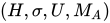
An indirect measurement model, introduced in Ozawa (1984)[1]
Quantum measuring processes for continuous observables
J. Math. Phys., 25 (1984), pp. 79-87 Google Scholar</ref> as a “(general) measuring process”, is a quadruple
Failed to parse (MathML with SVG or PNG fallback (recommended for modern browsers and accessibility tools): Invalid response ("Math extension cannot connect to Restbase.") from server "https://wikimedia.org/api/rest_v1/":): {\displaystyle (H,\sigma,U,M_A)}
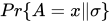
consisting of a Hilbert space Failed to parse (MathML with SVG or PNG fallback (recommended for modern browsers and accessibility tools): Invalid response ("Math extension cannot connect to Restbase.") from server "https://wikimedia.org/api/rest_v1/":): {\displaystyle \mathcal{H}} , a density operator Failed to parse (MathML with SVG or PNG fallback (recommended for modern browsers and accessibility tools): Invalid response ("Math extension cannot connect to Restbase.") from server "https://wikimedia.org/api/rest_v1/":): {\displaystyle \sigma\in S(\mathcal{H})} , a unitary operator Failed to parse (MathML with SVG or PNG fallback (recommended for modern browsers and accessibility tools): Invalid response ("Math extension cannot connect to Restbase.") from server "https://wikimedia.org/api/rest_v1/":): {\displaystyle U} on the tensor product of the state spaces of Failed to parse (MathML with SVG or PNG fallback (recommended for modern browsers and accessibility tools): Invalid response ("Math extension cannot connect to Restbase.") from server "https://wikimedia.org/api/rest_v1/":): {\displaystyle S} andFailed to parse (MathML with SVG or PNG fallback (recommended for modern browsers and accessibility tools): Invalid response ("Math extension cannot connect to Restbase.") from server "https://wikimedia.org/api/rest_v1/":): {\displaystyle M,U:\mathcal{H}\otimes\mathcal{H}\rightarrow \mathcal{H}\otimes\mathcal{H}} and a Hermitian operator Failed to parse (MathML with SVG or PNG fallback (recommended for modern browsers and accessibility tools): Invalid response ("Math extension cannot connect to Restbase.") from server "https://wikimedia.org/api/rest_v1/":): {\displaystyle M_A} on Failed to parse (MathML with SVG or PNG fallback (recommended for modern browsers and accessibility tools): Invalid response ("Math extension cannot connect to Restbase.") from server "https://wikimedia.org/api/rest_v1/":): {\displaystyle \mathcal{H}} . By this measurement model, the Hilbert space Failed to parse (MathML with SVG or PNG fallback (recommended for modern browsers and accessibility tools): Invalid response ("Math extension cannot connect to Restbase.") from server "https://wikimedia.org/api/rest_v1/":): {\displaystyle \mathcal{H}} describes the states of the apparatus Failed to parse (MathML with SVG or PNG fallback (recommended for modern browsers and accessibility tools): Invalid response ("Math extension cannot connect to Restbase.") from server "https://wikimedia.org/api/rest_v1/":): {\displaystyle M} , the unitary operator Failed to parse (MathML with SVG or PNG fallback (recommended for modern browsers and accessibility tools): Invalid response ("Math extension cannot connect to Restbase.") from server "https://wikimedia.org/api/rest_v1/":): {\displaystyle U} describes the time-evolution of the composite system Failed to parse (MathML with SVG or PNG fallback (recommended for modern browsers and accessibility tools): Invalid response ("Math extension cannot connect to Restbase.") from server "https://wikimedia.org/api/rest_v1/":): {\displaystyle S+M} , the density operator Failed to parse (MathML with SVG or PNG fallback (recommended for modern browsers and accessibility tools): Invalid response ("Math extension cannot connect to Restbase.") from server "https://wikimedia.org/api/rest_v1/":): {\displaystyle \sigma} describes the initial state of the apparatus , and the Hermitian operator describes the meter observable of the apparatus . Then, the output probability distribution in the system state is given by
where is the spectral projection of for the eigenvalue .
The change of the state of the system caused by the measurement for the outcome is represented with the aid of the map in the space of density operators defined as
| Failed to parse (MathML with SVG or PNG fallback (recommended for modern browsers and accessibility tools): Invalid response ("Math extension cannot connect to Restbase.") from server "https://wikimedia.org/api/rest_v1/":): {\displaystyle \mathcal{P}_A(x)\rho= Tr_\mathcal{H}[\Bigl(I\otimes E^M{^{_A}(x)\Bigr)}U(\rho \otimes\sigma)U^*]} | Failed to parse (MathML with SVG or PNG fallback (recommended for modern browsers and accessibility tools): Invalid response ("Math extension cannot connect to Restbase.") from server "https://wikimedia.org/api/rest_v1/":): {\displaystyle (19)} |
where Failed to parse (MathML with SVG or PNG fallback (recommended for modern browsers and accessibility tools): Invalid response ("Math extension cannot connect to Restbase.") from server "https://wikimedia.org/api/rest_v1/":): {\displaystyle Tr_\mathcal{H}} is the partial trace over Failed to parse (MathML with SVG or PNG fallback (recommended for modern browsers and accessibility tools): Invalid response ("Math extension cannot connect to Restbase.") from server "https://wikimedia.org/api/rest_v1/":): {\displaystyle \mathcal{H}} . Then, the map Failed to parse (MathML with SVG or PNG fallback (recommended for modern browsers and accessibility tools): Invalid response ("Math extension cannot connect to Restbase.") from server "https://wikimedia.org/api/rest_v1/":): {\displaystyle x\rightarrow\Im_A(x)} turn out to be a quantum instrument. Thus, the statistical properties of the measurement realized by any indirect measurement model Failed to parse (MathML with SVG or PNG fallback (recommended for modern browsers and accessibility tools): Invalid response ("Math extension cannot connect to Restbase.") from server "https://wikimedia.org/api/rest_v1/":): {\displaystyle (H,\sigma,U,M_A)} is described by a quantum measurement. We remark that conversely any quantum instrument can be represented via the indirect measurement model (Ozawa, 1984).[1]Thus, quantum instruments mathematically characterize the statistical properties of all the physically realizable quantum measurements.